Skip to content

Contact Us

Quinton Q-Tel RMS

The Q-Tel Cardiac Rehabilitation Management System simplifies workflow to allow clinicians to spend more time with patients working on their cardiac rehab programs and less time producing documentation and reports. The system's wireless Pocket Assistant allows you to control session parameters from the floor, and Windows-based software provides familiar icons and an intuitive interface. Forms and reports in the Microsoft Excel file format are easily customizable to suit your program's requirements.

NEW! – Q-Tel is the first DICOM-compatible cardiac rehabilitation system in the market! Click here for the DICOM Conformance Statement.

The Q-Tel system can link easily to your PACS/HIS/EMR system using industry standard HL7, DICOM, XML, or PDF protocols so you can download patient demographic information and upload session data.

The Q-Tel RMS also offers seamless integration with the Orion Outcomes Data Management System. And you can add the Quinton Q-Exchange option for bi-directional communication with your medical informatics system.

Features

  • Diagnostic-quality electrocardiogram (ECG / EKG) displays
  • Wireless Q-Tel Pocket Assistant for controlling cardiac rehabilitation sessions from the floor
  • Windows-based interface
  • Forms and reports generated in Microsoft Excel format
  • Monitors 12 cardiac patients at a single station (up to 32 when networked)
  • Option to network with HIS and EMR clinical systems
  • Built-in life-threatening alarms (for asystole, ventricular fibrillation (v-fib) and ventricular tachycardia (v-tach))
  • 22 built-in administrative and clinical reports
  • Tools to support your American Association of Cardiovascular and Pulmonary Resuscitation (AACVPR) certifications
  • Warranty: 13 month parts and labor

Benefits

  • Ease of Use. The Windows-based interface uses familiar drag-and-drop functions, consistent pull-down menus, auto-populating and auto-indexing data fields.
  • Connectivity. The system links easily to hospital information systems so you can download patient demographic information and upload session data.
  • Accuracy. The Quinton Q-TEL RMS captures and displays ECG signals with diagnostic accuracy.
  • Clarity. Simple left-to-right icons match the typical workflow for most cardiac rehab programs, and each program module is accessible with just one click.
  • Reporting. The Q-Tel RMS 3.1 provides all the reports you need, including Patient Intake Assessment, Patient Care Plan, a Customizable Patient Query Report, and Customized Patient Outcomes Graphs.
  • Integration. The system integrates seamlessly with the Orion Outcomes Data Management system, the standard for outcome reporting for cardiac rehabilitation.
  • Reliability. The Q-Tel RMS 3.1 is tested to the highest standards; many of our older systems still going strong after more than 10 years of reliable service.
  • Support. We provide excellent support and service including a 13-month on-site warranty, 2 days of in-service training, free phone tech support, remote support, and competitively priced service contracts.

Please give me more information about the Quinton Q-Tel RMS

My name:
My email:
My phone:
My zipcode:
What I'm looking for:
Receive Cardiac Science news and promotions by email:
Call 800.679.8703 or
 

ECG PERFORMANCE

Applicable standards:

AAMI EC-11-1991 for diagnostic ECG (The Q-Tel RMS system meets or exceeds the following performance requirements of AAMI EC-11: gain accuracy, frequency response, CMRR, system noise, dynamic range, and input impedance)

Display and analysis filter:

Muscle artifact, baseline wander and 50/60 Hz line. User can turn all filters on or off


ECG DISPLAY

Content:

4, 8 and 12 channel ECG display and alphanumeric data I/O

Display:

3.5 - 8 seconds, depending upon number of channels

Data:

ECG traces, heart rate, target heart rate, blood pressure, patient demographics and risk profiles, workload, METs, RPE, patient weight, and other user selectable parameters

Gain:

2.5, 5, 10, 20, 40 mm/mV

Lead groups:

4 and 5 wire lead sets, supporting the standard limb set, limb plus one chest lead, and the modified chest lead


ECG ANALYSIS

Heart rate:

Moving median estimate based upon R-R intervals

Alarms:

Includes 7 programmable technical alarms and up to 13 programmable arrhythmia alarms with automatic strip print or automatic strip record


POWER REQUIREMENTS:

100/120 VAC 50/60 Hz nominal 2.5 A; 200/240 VAC 50/60 Hz nominal 1.3 A


ENVIRONMENTAL

Operating temperature:

50°F to 90°F (10°C to 32°C)

Operating relative humidity:

20% to 80% non-condensing

Storage temperature:

32°F to 113°F (0°C to 45°C)

Storage relative humidity:

10% to 90% with condensation

Ventilation clearances:

Workstation: 6 in (min) behind; Laser printer: 3 in (min) on each side


MASTER TOWER

CPU:

Intel compatible PC platform, P4 3.4 GHz processor (min)

RAM:

1 GB (min)

Hard drive:

2x80 GB SATA (min)


SLAVE TOWER AND
TURNKEY WORKSTATION

CPU:

Intel compatible PC platform, P4 3.4 GHz processor (min)

RAM:

512 MB (min)

Hard drive:

80 GB SATA (min)


DISPLAY:

Color LCD, 1280 x 1024; 19 in or 21 in (483 mm or 533 mm)


KEYBOARD AND MOUSE:

Keyboard: main 101 keys, QWERTY layout; Mouse: optical with magnifying function


X12+ TRANSMITTER

Channel:

Easily select any 1 of 64 channels using the function keys

Display:

1.25 in x 0.62 in (3.2 cm x 1.6 cm) LCD display shows live ECG, lead fail, lead quality, power ON/OFF, low battery

Lead Connector:

Single-block, 4 or 5 lead

Function Keys:

Up/Right, Down and Enter keys for ON, menu navigation and CALL

Frequency Range:

WMTS 608 MHz (608.48 MHz to 613.52 MHz) or outside USA: 2400 MHz (2400.96 MHz to 2482.56 MHz)

Patient Isolation:

Positive defibrillation protection in compliance with AAMI standards and IEC 601-2-25

Patient Call Button:

Depression of any button while monitoring inserts the call signal into the transmitted data stream

Radiated Power:

Does not exceed 0.5 mW

Dimensions (H x D x W):

3.5 in x .98 in x 2.5 in (9.1 cm x 2.5 cm x 6.4 cm)

Weight:

With battery: 4.8 oz (136 g); Without battery: 4.0 oz (114 g)

Battery Type:

1 AA alkaline

Battery Duration:

40 hours (typical)

Data Stream Content:

Encoded lead potentials, battery voltage, lead potency or impedance

Sample Rate:

500 samples/second/channel

Pacemaker Spike Detection:

10,000 samples/second/channel at the transmitter. Detected pacemaker spikes are transmitted as part of the encoded data stream and are displayed in all acquired leads.

Environmental:

Water resistant, classified according to IEC-601-1 and IEC-601-2-25 as ordinary equipment


RECEIVER

Sensitivity:

-100 dBm

Antenna:

Dual passive antenna system. Open field range: 100+ meters. Optional powered antenna system available to extend coverage

Channels:

64 channels per receiver for 608 MHz and 2400 MHz systems

Receiver Board:

Available as 4 or 8 independent receivers per receiver board. Up to 12 receivers per tower.

Leads:

4 or 5 leads of diagnostic ECG data per receiver

Bandwidth:

0.5 Hz to 100 Hz (min). The ECG bandwidth: determined by transmitter and is diagnostic according to AAMI-EC 11-1991


CHART RECORDER

Recording technique:

High-resolution thermal dot array, temperature controlled thermal print head

Printed data:

One and two channel ECG waveforms and alphanumeric printing

Speed:

25 mm/sec

Paper:

Blank or pre-gridded thermal, ECG grid, 5 cm (2 in) wide rolls

Feed:

Continuous from roll


PRINTER

Lazer printer:

High volume HP 4250N, LexMark T654 or Low volume HP 2015dn, LexMark e360dn

Paper dimensions:

8.5 in x 11 in (US letter) or 210 mm x 300 mm (A4)

Resolution:

600 dpi (minimum)


NETWORK SWITCH

Type:

10/100 (10BASE-T/100BASE-TX)

Interface:

RJ-45, 100 ohm, UTP cable

Ports:

8 RJ-45 ports, twisted pair, fixed crossover

MAC address table:

2000 entries

Dimensions (H x D x W):

1.26 in x 3.34 in x 6.93 in (3.2 cm x 8.5 cm x 17.6 cm)

Weight:

0.794 lb (0.36 kg)


EXTERNAL HARD DRIVE

Type:

USB 2.0

Speed:

7200 RPM

Media Format/Type:

NTFS

Capacity:

320 GB (min)


CD-RW DRIVE

Type:

52/32/52 (min)

Speed:

52X (CD-R burn)/32X (CD-RW burn)/52X (CD-ROM read) (mmin)

Media/media capacity:

CD-R (74 min or 80 min)


REPORTS

Outcomes:

11 standard outcomes reports covering individual session results, progressreports, and full disclosure

Administrative:

11 standard reports including daily billing, physician list, patient demographics, and statistical summaries.


OFF-THE-SHELF:

Windows XP, Microsoft Office Basic 2007, or 2010, Microsoft SQL 2000 (MSDE), Adobe Acrobat Reader 6.0 Cardiac Science recommends installing all Microsoft critical and security updates on an ongoing basis to protect the Q-Tel RMS system from Internet based attacks. Additionally, a commercially available anti-virus software package should be used with Q-Tel RMS. Virus scanning should not be performed on the system when using the Q-Tel RMS application. In all cases, Q-Tel RMS application files must be excluded from the virus scan. Cardiac Science does not recommend installing any other unqualified software on your Q-Tel RMS system.


CARDIAC SCIENCE CORP.:

Q-Tel RMS software, Q-Progress software, Purge/Archive utility, Backup/Restore utility


NETWORKING:

Microsoft compatible networking for file storage, distribution, and e-mail (Novel networks are not supported)


SERVICE:

Cardiac Science field service representative or qualified technician only


APPROVED PERIPHERALS

LCD:

19 in (483 mm) Viewsonic VP191 or VP960; Dell P190S; NEC LCD93VX; Planar PL1910M

Printer:

21 in (533 mm): Viewsonic VP2130b; NEC LCD2190UXP-BK, LCD2190UXi, or LCD2190UXp; Planar PX212M-BK

Pocket Assistant (PDA):

HP 2400; HP 110/210; Asus A626; Dell X30 with extended battery; Dell X51 with extended battery

External Hard Disk Drive:

320 GB Iomega - 33653; 500 GB Western Digital - WDBAAU5000EBK-00, WDBAAU5000EBK-NESN


SOFTWARE ONLY WORKSTATION

Minimum Specifications:

Processor: Intel Pentium 4, clock speed 2.4 GHz or faster; System memory: 512 MB (min); USB Ports: 1 for optional USB printer; CD drive: 8X or faster; Hard drive: 20 GB (min); Video: 16 MB (min); capable of 16 bit high-color, 1280 x 1024 resolution; Operating system: Windows XP Professional, SP2 or SP3, Windows 7 (32-bit)

The Quinton Q-Tel RMS Rehabilitation Management System is a very customizable system. Please contact us for details.
Carry Case for X12+ Telemetry Transmitter

Reuseable nylon pouch with adjustable waist belt.

Image Unavailable Telemetry Transmitter Lead Set - 5-Wire AHA

5-wire AHA lead set has color-coded and labeled (RA, RL, LA, LL,V) snap connectors.

Image Unavailable Telemetry Transmitter Lead Set - 4-Wire IEC

4-wire IEC lead set has color-coded and labeled (R, L, F, N) snap connectors.

Image Unavailable Telemetry Transmitter Lead Set - 5-Wire IEC

5-wire IEC lead set has color-coded and labeled (R, L, F, N, C) snap connectors.

Thermal Paper for Strip Chart Recorder

Measures 1.97 in (5.0 cm) wide by 100 ft (30.5 m) long and prints black on white.

Quick-Trace ECG Electrodes Quick-Trace ECG Electrodes

Feature snap connector, perforated circular clear tape, and low-chloride hydrogel.

Telemetry Transmitter Lead Set 4-Wire AHA

4-wire AHA lead set has color-coded and labeled (RA, RL, LA, LL) snap connectors.

The system links easily to hospital information systems (HIS) so you can download patient demographic information and upload session data.

FAQs & Troubleshooting Tips

Are AEDs reliable?

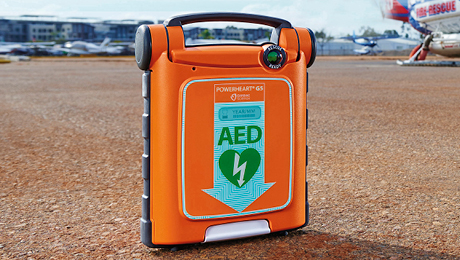
The patented Rescue Ready technology makes the Powerheart AED among the most reliable AEDs in the industry. Everyday, to ensure anytime functionality, the Powerheart AED self checks all main components (battery, hardware, software, and electrode pads). Every week, the AED completes a partial charge of the high-voltage electronics. And every month, the AED charges the high-voltage electronics to full energy. If anything is amiss, the Rescue Ready status indicator on the AED handle changes from green to red and the device emits an audible alert to service the unit. In sum, a Powerheart AED is Rescue Ready to perform when a life depends on it.

Does Remote Support cost anything?

This service is available free of charge for our warranty and service contract customers. Billable customers are charged the standard hourly service rate.

How do I set up Remote Support on my Cardiac Science equipment?

Several methods are available. Examples of the most popular are PC Anywhere, Real VNC (Virtual Network Computing) or WebEx Intercall. Contact Technical Support for more details.

How does Remote Support benefit me?

We have the availability of experts to assist you in real time, without having to send your unit in, or sending a field service engineer on site. We can assist you with installing software and service patches. We can help identify workflow issues, verifiy versions and software settings. We can view and send log files to our FTP site. This has proved to be a valuable tool in resolving issues quickly meaning increased uptime for your equipment.

I am getting "Error: 1004" when launching Q-Progress application.

In Q-Progress, go to View > Options and verify the storage directory path: For Master Tower: The path should be C:\Program Files\Quinton\Q-Tel RMS\QProgressCSVData. For Slave Tower, Turnkey Workstation or Software-Only Worksation: The path should be [mapped drive letter]\QProgressCSVData.

Is Remote Support safe and secure?

Yes. Remote Support is safe and secure. Information is shared only between your computer, and the computer of the Technician working on your issue.

Medical Record Number (MRN) has invalid characters.

Edit MRN in Q-Tel RMS Tower or Q-Tel RMS Workstation application.

Microsoft Office suite needs to be activated.

Close Q-Progress and launch Microsoft Excel and follow the prompts to activate if you have an internet connection, or call Microsoft at the number provided in the Excel application.

QProgressCSVData folder is not shared or has insufficient permissions.

Verify this folder is shared with Full Control permissions for Qtel User and Qtel Admin accounts.

The report is corrupt.

Note filename and delete file. Regenerate new copy.

What is Remote Support?

Remote Support is the ability for the Cardiac Science Technical Support Team to access your PC directly. We can connect to your PC remotely and control the actions temporarily. We can also help fix problems and review log files over a secure internet connection.